
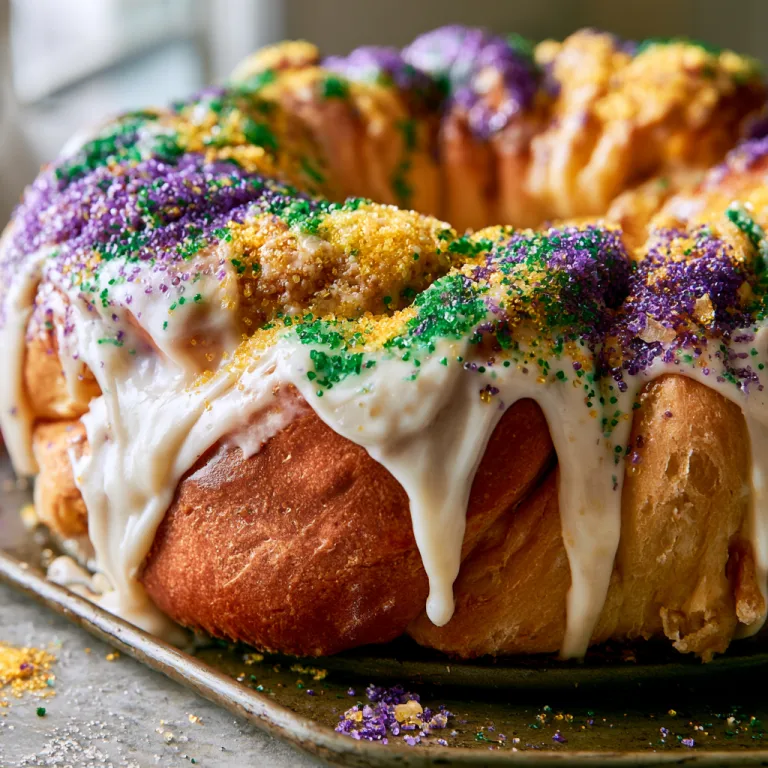
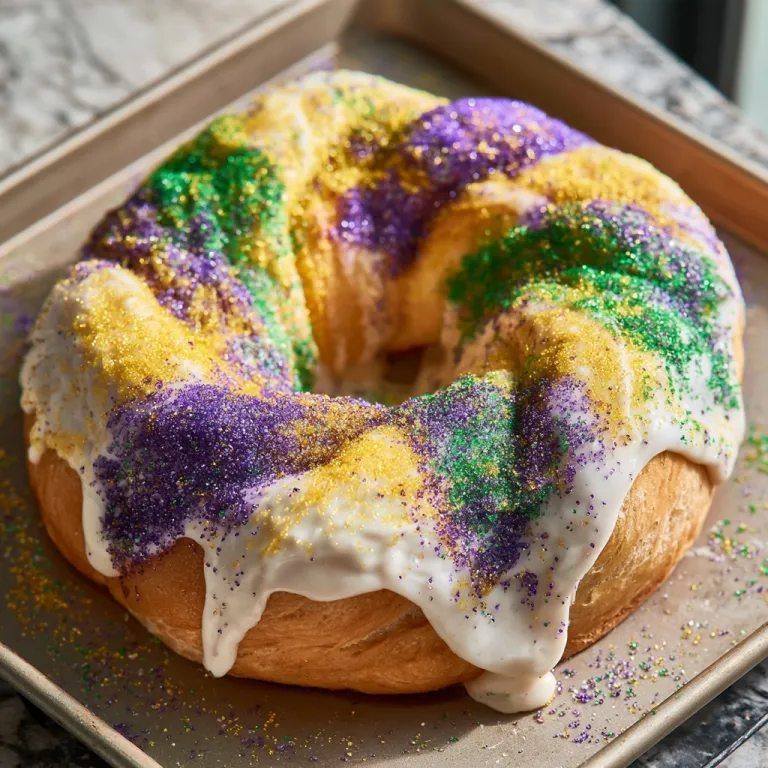
A soft, buttery yeast bread twisted into a ring, swirled with cinnamon sugar, then finished with a lemony glaze and showers of purple, green and gold sugar.
This traditional New Orleans king cake is the sweet, festive heart of every Mardi Gras celebration.
Let’s talk about what a king cake really is. It’s not a fluffy layer cake.
It’s closer to a giant cinnamon roll: an enriched yeast dough flavoured with lemon zest and a little nutmeg, rolled up around a cinnamon-sugar filling and shaped into a ring.
It bakes up golden and tender, and the glaze and coloured sugars make it look like a party.
Then there’s the tradition. A tiny plastic baby (or a bean, coin or trinket) is hidden in the cake, and whoever finds it in their slice is crowned “king” for the day and, by custom, brings the next king cake.
Bake it for Mardi Gras, Fat Tuesday or any time from Twelfth Night through Carnival season.
Why You’ll Love This King Cake
- Soft, tender dough: enriched with butter, milk and egg yolks.
- Cinnamon swirl: like a big, festive cinnamon roll.
- Lemony glaze: sweet with a fresh, bright finish.
- Classic Mardi Gras colours: purple, green and gold sugars.
- Fun tradition: hide a baby and see who finds it.
Ingredient Notes & Easy Substitutions
Active dry yeast – Make sure it’s fresh and active. Dissolve it in water between 110°F and 115°F. Any cooler won’t wake it up, and any hotter will kill it, so a thermometer helps.
Butter, milk and egg yolks – Make the dough rich and soft. Warm the milk to the same 110°F to 115°F as the water.
Sugar – Some sweetens the dough and the rest mixes with cinnamon for the filling.
Lemon zest and nutmeg – Give the dough its subtle, classic flavour.
All-purpose flour – Spoon and level it. Add just enough of the remaining flour to make a soft, slightly sticky dough. Too much makes the cake dry and dense.
Glaze and coloured sugars – Confectioners’ sugar, lemon juice and water make the glaze. If you can’t find purple, green and gold sugars, you can tint granulated sugar with food colouring.
Step-by-Step Guide to Making King Cake
1. Make the dough
Dissolve the yeast in the warm water, then beat in half the sugar, the butter, milk, egg yolks, salt, lemon zest, nutmeg and 2 cups of flour until smooth. Stir in just enough of the remaining flour to make a soft, sticky dough.
2. Knead and rise
Knead on a floured surface for 6 to 8 minutes, until smooth and springy. Pop it in a greased bowl, cover and let it rise somewhere warm until doubled, about an hour.
3. Fill and shape
Punch the dough down and roll it into a 16×10-inch rectangle. Sprinkle with the cinnamon sugar, leaving a little border, then roll it up from a long side. Pinch the seam, set it seam side down on a greased baking sheet, and join the ends into a ring.
4. Second rise and bake
Cover and let it rise again until doubled, about an hour. Brush with beaten egg and bake at 375°F for 25 to 30 minutes, until golden brown. Let it cool completely.
5. Hide the baby, glaze and decorate
If you’re hiding a baby or trinket, poke it in from underneath once the cake is cool. Mix up the glaze, spread it over the top, and sprinkle generously with purple, green and gold sugars.
Traditional New Orleans King Cake
Equipment
- Large mixing bowl
- Kitchen thermometer
- Rolling Pin
- Baking sheet
- Wire rack
Ingredients
Cake
- 2 packages (1/4 oz each) active dry yeast
- 1/2 cup warm water 110°F to 115°F
- 3/4 cup sugar divided
- 1/2 cup butter softened
- 1/2 cup warm 2% milk 110°F to 115°F
- 2 large egg yolks room temperature
- 1 1/4 teaspoons salt
- 1 teaspoon grated lemon zest
- 1/4 teaspoon ground nutmeg
- 3 1/4 - 3 3/4 cups all-purpose flour
- 1 teaspoon ground cinnamon
- 1 large egg beaten
Glaze
- 1 1/2 cups confectioners' sugar
- 2 teaspoons lemon juice
- 2-3 tablespoons water
- green, purple and yellow sugars for decorating
Instructions
- Dissolve the yeast in the warm water in a large bowl. Add 1/2 cup of the sugar, the butter, milk, egg yolks, salt, lemon zest, nutmeg and 2 cups of the flour, and beat until smooth. Stir in enough of the remaining flour to make a soft, sticky dough.
- Turn out onto a floured surface and knead for 6 to 8 minutes, until smooth and elastic. Put it in a greased bowl, turning once to grease the top. Cover and leave somewhere warm until doubled, about 1 hour.
- Punch the dough down and roll it out on a lightly floured surface into a 16x10-inch rectangle. Mix the cinnamon with the remaining 1/4 cup sugar and sprinkle it over the dough, leaving 1/2 inch clear around the edges.
- Roll the dough up tightly from a long side, like a jelly roll, and pinch the seam to seal. Set it seam side down on a greased baking sheet and pinch the ends together to make a ring. Cover and let rise until doubled, about 1 hour.
- Brush the ring with the beaten egg and bake at 375°F for 25 to 30 minutes, until golden brown. Cool completely on a wire rack.
- If hiding a toy baby or trinket, push it in from the underside of the cooled cake so it can't be seen. Never bake it inside the cake.
- Stir the confectioners' sugar, lemon juice and enough water together to make a spreadable glaze. Spread over the cake and sprinkle with the coloured sugars.
Notes
- Yeast: Check the yeast is in date and active. The water and milk must be between 110°F and 115°F: cooler won't wake the yeast and hotter will kill it.
- Flour: Spoon and level it; too much flour makes a dry, dense cake.
- Storage: Keep airtight at room temperature for 1 to 2 days, or in the fridge for 3 to 5 days, well covered so it doesn't dry out.
- Freezing: Freeze the unglazed cake for up to 3 months.
- Nutrition: Estimated per piece from the ingredients (using 3 1/2 cups flour and salted butter).
Nutrition
Tips for the Best King Cake
- Use a thermometer: 110°F to 115°F is the sweet spot for the yeast.
- Test your yeast: it should foam before you add everything else.
- Don’t overdo the flour: a slightly sticky dough gives the softest cake.
- Rise somewhere warm: it helps the dough double properly.
- Seal the seam well: so the filling doesn’t leak.
- Cool before glazing: otherwise the glaze melts off.
Common Mistakes to Avoid
- Liquids too hot or cold: the yeast won’t work. Stick to 110°F to 115°F.
- Too much flour: it makes a dry, heavy cake.
- Rushing the rises: let the dough truly double each time.
- Baking the baby inside: add it only after baking, from the bottom.
- Glazing a warm cake: wait until it’s completely cool.
Easy Ways to Change It Up
The recipe card is the classic version. These are optional ideas:
- Cream cheese filling: spread sweetened cream cheese over the dough before rolling.
- Praline or almond filling: other popular king cake fillings.
- Fruit filling: try a thin layer of fruit preserves.
- Frosting instead of glaze: use vanilla frosting for an extra-sweet finish.
- DIY coloured sugar: tint granulated sugar with food colouring.
How to Serve King Cake
Slice it into 12 pieces and serve with coffee, especially chicory coffee for a true New Orleans touch. It’s the star of any Mardi Gras party, and don’t forget to warn guests about the hidden baby!
Make-Ahead and Storage Tips
- Room temperature: store airtight for 1 to 2 days.
- Fridge: keep well covered for 3 to 5 days.
- Freezer: freeze the unglazed cake for up to 3 months. Thaw, then glaze and decorate before serving.
Frequently Asked Questions
Why is there a baby in a king cake?
It’s a Mardi Gras tradition. Whoever finds the baby in their slice is “king” for the day and traditionally brings the next king cake.
When should I put the baby in the king cake?
After baking and cooling. Push it in from the bottom so it’s hidden. Never bake it inside.
Why didn’t my king cake rise?
The yeast may be old, or the water and milk may have been too hot or too cold. Keep them between 110°F and 115°F.
Can I freeze king cake?
Yes. Freeze it before glazing for up to 3 months.
What do the colours on a king cake mean?
Purple, green and gold are the traditional Mardi Gras colours, often said to stand for justice, faith and power.
Soft, sweet and swirled with cinnamon, this king cake brings all the joy of Mardi Gras to your own kitchen.
Bake one, hide the baby, and let the celebrations begin.